First, Work Out Which Drain Is Clogged
Start by running water in the other fixtures. If only one sink, tub or toilet is slow, the blockage is almost certainly in that fixture's own trap or branch line, and the methods below are safe to try. If two or more fixtures are slow at once, or flushing the toilet makes water rise in the tub, the blockage is in a shared line or the main sewer lateral, and no amount of plunging at one fixture will fix it.
Elgin's older homes make this check more important than it looks. The historic districts around Gifford Park, Spring-Douglas and the National Watch area, plus the postwar ranches that fill much of the city, often share vertical stacks and short branch lines between a bathroom and a kitchen. A clog that looks like a slow bathroom sink can really be a shared stack problem.
The Plunger: The Right Tool and the Right Technique
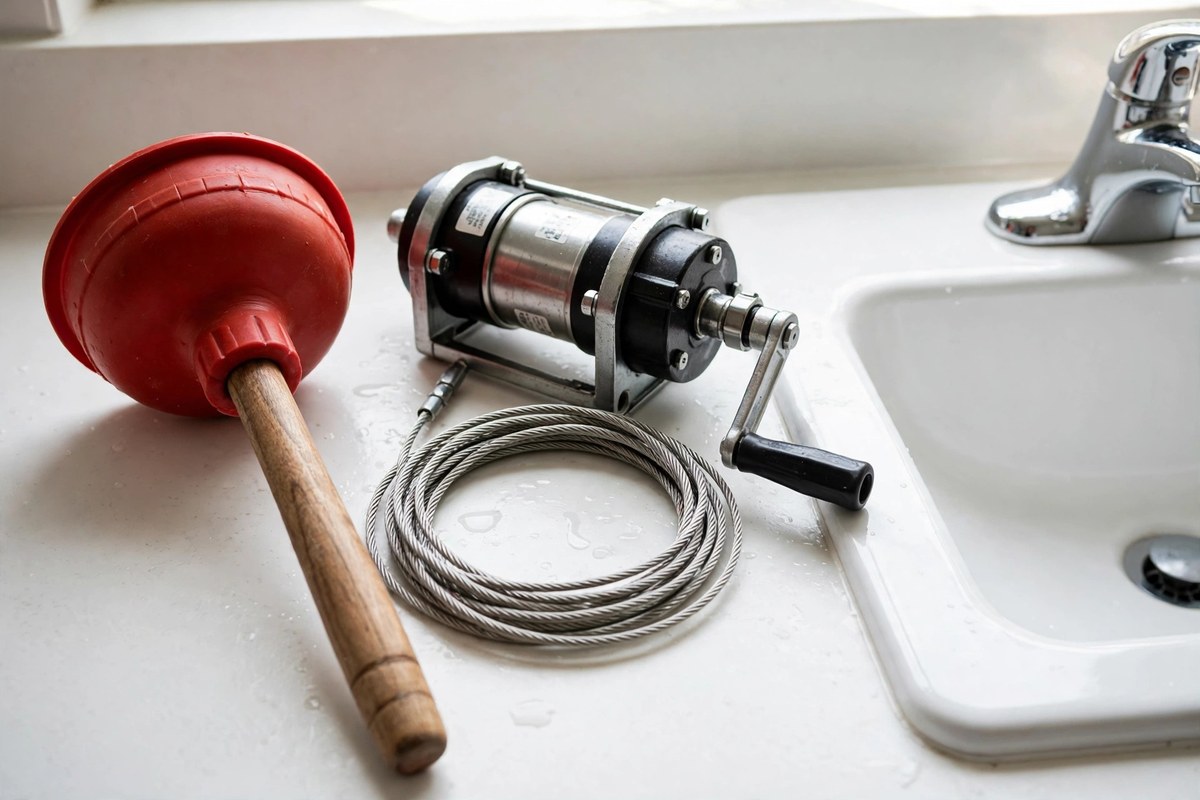
A plunger works by pushing and pulling a column of water against the clog, so it needs water in the fixture and a tight seal around the drain. Use a flat cup plunger on sinks and tubs, and a flange plunger, the kind with a rubber collar that folds out of the cup, on toilets. A sink plunger will not seal a toilet bowl, and a toilet plunger will not seal a flat sink.
Cover the drain opening completely, then push down firmly and pull up sharply, keeping the cup sealed to the surface, for 15 to 20 strokes. Short, fast strokes build the pressure that moves a soft clog. If the water starts to drain, run hot tap water for a minute to flush the loosened material through. If three rounds change nothing, the clog is too far down the line or too solid for a plunger, and the next step is a hand auger.
One rule before you start: if a chemical drain cleaner has already been poured into the fixture, do not plunge, because it splashes caustic liquid that can burn skin and eyes. Leave the fixture alone and call a licensed local plumber, and tell them what was poured in.
Kitchen and Bathroom Sinks: Hair, Soap Scum and Hard Water
Most bathroom sink and tub clogs are hair bound together with soap scum, and they usually sit in the pop-up stopper or the first few inches of the trap. Lift out the stopper or the drain strainer and pull the hair out by hand before trying anything else. A plastic drain stick with small barbs can reach a little farther.
Kitchen sink clogs are usually grease. Hot water melts grease just long enough for it to travel a few feet down the line, where it cools and hardens again, so a drain that clears with hot water and slows again a day later is almost always a grease clog. Pouring more hot water only moves the problem farther from the sink. A hand auger or a professional cable is the fix, not another kettle of water.
Elgin's water plays a part here too. The city softens its Fox River supply to about 7 to 8 grains per gallon, which is hard by the USGS scale, and older cast iron pipes in the historic districts build up mineral scale on their rough inner walls year after year. Scale narrows the pipe, so a drain that used to clear with a plunger starts needing one every month.
Baking soda and vinegar will not clear a clog. The fizz is only carbon dioxide gas escaping, and it has no effect on hair, grease or scale. It is harmless to the pipes, so it wastes nothing but time, and a slow drain left standing breeds odor and can back up without warning.
The Hand Auger: When the Plunger Is Not Enough
A hand-crank drum auger, usually sold as a 25-foot drain snake, reaches clogs a plunger cannot. Feed the cable slowly into the drain while turning the crank clockwise, and keep a light grip so you can feel what the tip meets. When the cable meets resistance, turn the crank steadily to work the tip through the clog, then pull the cable back slowly so the material comes out with it.
Two cautions matter. First, never force the cable. If it stops dead and will not advance with gentle turning, it has hit a bend, a joint or a broken section of pipe, and forcing it can crack an old cast iron elbow or punch through a clay lateral. Second, keep the cable out of the toilet: a drain snake will scratch porcelain glaze and can wedge a solid object tighter into the trapway.
Clean and dry the cable and drum after every use, or the cable will rust in the drum and seize. If the auger brings back black scale, gritty mineral flakes or fine roots, the line has a bigger problem than a single clog, and the next step is a camera inspection.
Toilet Clogs: Flange Plunger and Closet Auger
Most toilet clogs are paper and waste caught in the trapway, and a flange plunger clears them. Seat the rubber flange inside the bowl outlet so it seals, make sure there is enough water in the bowl to cover the cup, and use the same firm push and sharp pull as on a sink. The first push should be gentle, just enough to seat the seal.
If the bowl is full to the rim, do not flush again: a second flush sends another gallon and a half into a bowl that cannot drain, and it will overflow. Scoop out some water first, then plunge. If the water level keeps rising on its own, or flushing makes water appear in the tub or shower, stop: that is a main line blockage, not a toilet clog.
A closet auger is the next tool when the plunger fails. Its curved tube guides a short cable through the trapway without touching the porcelain, and its vinyl sleeve protects the glaze. Feed it slowly, crank through the resistance, and retrieve it the same way. If the auger meets a hard object that will not move, it is probably a solid item dropped into the bowl, and ramming it only wedges it tighter. That is a job for a licensed local plumber, who can pull the toilet and remove it from below.
What Never to Pour Down an Elgin Drain
Chemical drain cleaners are the most damaging thing a homeowner can pour down a drain. The liquids and gels sold in stores contain concentrated acid or lye, and the heat they generate softens PVC joints, pits cast iron and can crack a porcelain fixture. Elgin's historic homes still run on cast iron stacks and clay laterals, and acid eats the protective scale inside that old iron. The full case against chemicals is in the tools and pumps guide.
Grease is the second. Cooking oil, bacon fat and pan drippings harden as they cool, and in a cold Elgin lateral in January they set up like candle wax. Wipe pans with a paper towel and throw the towel away, and keep a jar by the stove for used oil. Coffee grounds, eggshells, pasta and rice also belong in the trash.
Nothing labeled flushable is safe for a drain. So-called flushable wipes do not break apart the way toilet paper does, and they are the most common cause of toilet and main line blockages. Cotton balls, cotton swabs, dental floss, bandages and cat litter are the same: they belong in the trash, not the toilet.
Method Comparison: What to Try, in Order
Unclogging Methods Compared for Elgin Homes
| Method |
Best For |
Typical Cost in Elgin |
Watch Out For |
| Plunger, cup or flange |
Soft clogs near the fixture |
No cost at home |
Splashing chemical cleaner poured in first |
| Stopper cleaning or drain stick |
Hair at the stopper or strainer |
No cost at home |
Cracking a stuck stopper |
| Hand auger, 25 ft |
Clogs past the trap in sinks and tubs |
Pro tub or shower snaking $165 – $240 |
Scratching porcelain, cracking old cast iron |
| Closet auger |
Toilet trapway clogs |
Pro toilet auger clearing $160 – $275 |
Wedging a solid object tighter |
| Professional cable or jetter |
Main line, roots, grease and scale |
Main lateral snaking $250 – $450, jetting $495 – $850 |
A cause that needs a camera check |
When to Stop and Call a Licensed Local Plumber
Put the tools down and call when more than one fixture is affected, when sewage or a strong sewer smell comes up through a drain, when water appears in a basement floor drain, or when the same drain clogs again within days of clearing it. A clog that returns that fast is not a new clog: it is a partial blockage, a bellied pipe, roots or scale.
A professional visit for a single fixture in Elgin typically runs $145 – $275, and a main sewer line clearing typically runs $250 – $450, with a camera inspection typically $195 – $350. Those are the ranges in the Elgin drain cleaning cost guide, and they cover standard daytime residential service. After-hours dispatch typically adds $75 – $150.
When you call, say which fixtures are affected, what you already tried, and whether anything was poured down the drain. A licensed local plumber will ask about the cleanout location, the age of the home and whether the problem is new or recurring.